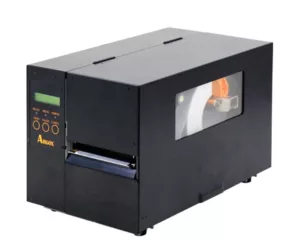
Industrial Barcode Label Printers – When a business outgrows standard office equipment, tracking inventory moves from a matter of organization to a critical core function. In high-velocity environments like massive distribution hubs, 24/7 manufacturing plants, and heavy logistics centers, smaller desktop units quickly reach their limits.
To keep supply chains moving without interruption, operations rely on an industrial barcode label printer.
These heavy-duty machines are built to withstand harsh environments while maintaining high throughput. Here is an overview of what makes an industrial printer different, where they are used, and how to know if your business requires one.

What is an Industrial Barcode Label Printer?
An industrial barcode label printer is a rugged, high-capacity machine engineered for high-volume, continuous printing operations.
Unlike desktop alternatives wrapped in plastic casings, industrial units feature all-metal internal mechanisms and reinforced steel housings. They are explicitly designed to run 24 hours a day, 7 days a week, processing thousands of labels per shift without overheating or failing.
Recommended Industrial Barcode Label Printers


Key Features Built for Demanding Environments
Industrial printers represent a major step up in both physical build and internal processing power. Their most defining features include:
- Massive Media Capacity: They house exceptionally large rolls of labels and high-capacity thermal ribbons (often up to 450 meters or more in length). This drastically reduces downtime caused by operators constantly stopping production lines to reload supplies.
- Blazing Print Speeds: While a standard desktop printer tops out around 4 to 6 inches per second (ips), high-end industrial models easily exceed 8 to 14 ips. This allows them to output hundreds of crisp compliance labels in minutes.
- Rugged Environmental Resistance: The metal enclosures shield sensitive electronic components from ambient dust, airborne particles, moisture, and accidental impacts common on factory floors.
- Advanced Connectivity and Integration: They frequently feature robust on-board processing, extensive network security protocols, multiple active connection types (Ethernet, USB, Serial, and dual-band Wi-Fi), and direct integration into complex Warehouse Management Systems (WMS) or Enterprise Resource Planning (ERP) platforms.
Primary Uses and Industrial Applications
Industrial barcode printers serve as the logistical backbone across several major global sectors:
1. Manufacturing and Product Identification
In manufacturing, components must be tracked from raw materials to finished goods. Industrial printers generate durable asset tags, component labels, and rating plates that remain legible even when exposed to heat, chemicals, or abrasion during assembly.
2. Warehousing, Logistics, and Distribution
Distribution hubs rely on high-speed printing to keep pace with incoming and outgoing freight. These printers produce large-format pallet labels, GS1-128 compliance labels, and shipping tags that ensure logistics networks can scan and route inventory accurately.
3. Food and Beverage Processing
With strict traceability regulations, food production plants use industrial thermal transfer technology to print clear batch numbers, expiration dates, and allergen warnings onto packaging materials that survive freezing or high-humidity cold storage.
4. Healthcare and Pharmaceuticals
From tracking bulk medication shipments to labeling thousands of laboratory specimen tubes daily, industrial units provide the extreme precision (often utilizing ultra-high resolution 600 dpi printheads) required to generate tiny, perfectly scannable barcodes on miniature vials.
Industrial vs. Desktop Label Printers: The Core Differences
Evaluating whether to transition to an industrial asset depends heavily on your daily volume and operational footprint:
| Feature | Desktop Label Printer | Industrial Label Printer |
| Chassis Build | Plastic housing | Die-cast aluminum / steel frame |
| Daily Output | 500 – 2,000 labels per day | 5,000 to continuous 24/7 printing |
| Max Print Speed | 4 – 6 inches per second | 10 – 14+ inches per second |
| Ribbon Capacity | 74 – 300 meters | 450 – 900 meters |
| Common Uses | Small retail, office shipping, file tracking | Logistics, manufacturing, bulk distribution |
Choosing the Right Industrial Unit for Your Operation
When selecting an industrial printer, it is important to match the technical specifications to your environmental realities. For standard warehousing applications, a 203 dpi model offers the fastest throughput for large shipping labels. However, if your facility prints tiny electronics labels or needs to match microscopic font requirements on pharmaceutical packaging, stepping up to a 300 dpi or 600 dpi model ensures small barcodes remain scannable.
By choosing a machine designed to match your specific volume, ribbon composition, and durability requirements, you secure a reliable asset that prevents supply chain bottlenecks and protects operational efficiency over the long haul.